
Each week, I have the privilege of working with leadership teams in various capacities: as a strategic advisor, coach, and workshop facilitator. At the start of each session, I routinely check in with everyone and ask how they are feeling.
Here’s a somewhat curious observation: the majority of people do not respond with a description of how they feel; instead, they tend to describe how busy they are!
Let me address this sense of perpetual "busyness" first, as it seems to dominate many conversations these days. But what does ‘being busy’ really mean?
Does it provide a greater sense of worth or purpose? Does it bring a sense of fulfilment? Or are we just going through the motions, potentially masking a feeling of being overwhelmed, frustrated or possibly ‘stuck in a rut’?
Now let me come back to the first point. Why do so many smart, well-educated individuals struggle to articulate how they’re feeling (or potentially avoid ‘going there’, certainly initially)?
In a world where leaders seem to embrace concepts such as emotional intelligence, empathetic leadership and psychological safety, it seems that many of the individuals within today’s organisations have lost – or possibly never had – a vital connection with understanding, or possibly an ability to articulate, what their own bodies are telling them.
So does this potential disconnect actually hold clues to what we really need to do differently as we look in 2026? Is this actually a far more important skill set than we realise?
Try taking a moment now to press pause. Take a few deep breaths. Notice not only what you’re thinking, but how you're feeling. How might you describe those feelings? The link below is to an emotions wheel, which can help you more accurately label different feelings.
In today’s article, I aim to unpack and explain a key principle that has helped to transform the lives of many people I know and work with, and also had a profound impact on my own life;
Managing energy, not time, is the fundamental currency of high performance.
Jim Loer, Co-Founder, Human Performance Institute
Shifting our mindset to focus on managing energy rather than time leads to fundamental changes in how we live and work, to our own benefit and to the benefit of those around us. There are a few simple actions that anyone can implement which have an immediate effect.
Fortunately, that includes reframing the idea of what we commonly refer to as ‘rest’ – so why not grab a comfy seat and read on!
Whether in our pursuit of goals and ambitions, or simply to keep our heads above water, the relentless ‘fight against the clock’ actually prevents us from achieving a sustainable level of even average performance, let alone reaching the peaks of sustained high performance.
But dedicating more hours to ‘work’ – whatever that happens to be – does not necessarily translate to improved performance – certainly not in the mid-to-long term.
And yet despite numerous studies supporting this notion (and a general shift in the way this is viewed in the business world) many individuals – and organisational cultures – continue to directly or indirectly encourage this mindset.
Many years ago, whilst being gently immersed (!) in the high performance world of the multi Gold Medal winning GB Olympic Rowing Team, and under the expert guidance of a former Royal Marine, I learnt two incredibly valuable life lessons:
1. The importance of taking regular 'breaks' and including periods of genuine 'rest' in your daily routines, and;
2. The concept of being 'properly selfish' - means prioritising your own needs first to better serve others.
Throughout my career, I've gained a far deeper understanding of this subject, and developed my own ‘rituals of recovery’ (more on these below), but it all started with that experience in the hands of the aforementioned Royal Marine. Having observed the impact the whole experience had on me, he encouraged me to look into the work of Jim Loehr and Tony Schwartz.
In fact, Loehr's book 'On Form' is a trusted recommendation for senior leaders and coaching clients I've worked with. A CEO recently reached out to me, expressing regret for not knowing about this work twenty years ago!
Dr Jim Loehr dedicated his professional life to the world of high performance. But for many years, he couldn’t pin-point what separated consistently high performing athletes from their rivals. After all, they all seemed to be incredibly driven and talented.
Then one day, he noticed something whilst watching two of the world’s best tennis players. The most consistently high-performing – and eventual winner – seemed to momentarily ‘zone out’, even between points, in the midst of an intense match – where surely sustained focus was key?
Ultimately, what Jim Loehr had discovered in that moment was that the highest performing athletes were able to perform at consistently high levels for sustained periods of time by “rapidly cycling between periods of full engagement and disengagement.”
By coincidence, at the same time Tony Schwartz was discovering a similar pattern in the corporate world as an executive coach i.e. despite being against the cultural norms and expectations of the time, the handful of senior executives who routinely paused for a break during their 18 hour days were consistently more high performing over longer periods of time, and suffered far less from stress and burnout.
As Schwartz wrote, “Taking breaks isn’t a sign of weakness but a sign of high performance.”
This is a good time to pause and reflect.
Over the last 2-3 days:
What might that mean in practice? Ask yourself:
Your answers to these questions may start to give you clues as to where you might need to focus your own ‘energy management’ practices and routines.
Everything we do, from work meetings to spending time with loved ones, relies on our energy. Yet, many of us overlook the significance of conserving and replenishing our energy - as it's something we often take for granted or don't think about at all.
In his work, Jim Loehr introduced four key energy management principles for us to follow and suggests a few useful tools and practices:
This article focuses primarily on Principle #1 and suggests a few useful, key practices to help you build and maintain your capacity for the four (separate, but related) human energy sources
“To be fully engaged we must be physically energised, emotionally connected, mentally focussed and spiritually aligned with a purpose beyond our immediate self interest.”
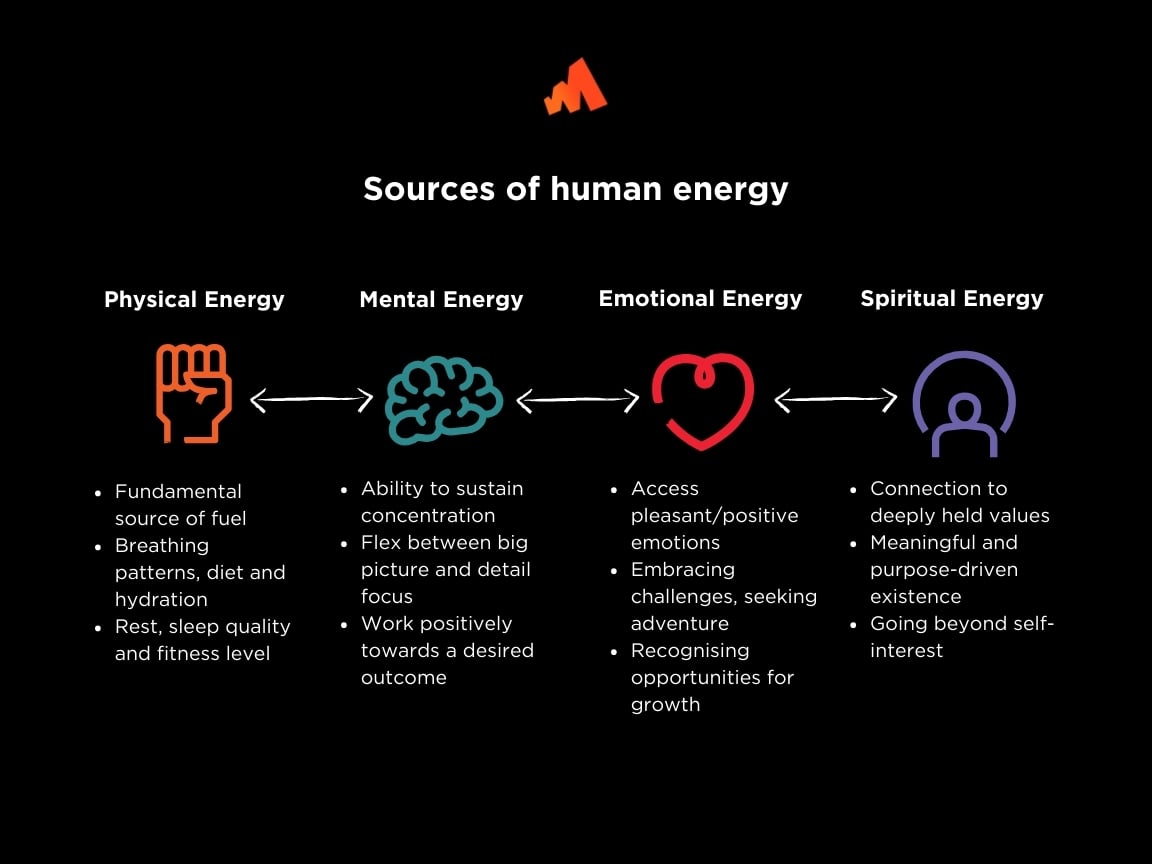
When managed well, the four sources can truly unlock high performance in a sustainable (and enjoyable) way. And in my experience people often overlook at least one of these sources. But they are all critical and interrelated as you will see below!
Maintaining and building our physical energy reserves is crucial for everyone – not just those who work in more physically demanding jobs (a common misconception). But it is universally essential. Factors such as sleep, hydration, nutrition, and exercise have a significant impact on our physical energy levels.
As does breathing.
And rest!
NOTE! Unlike other energy sources, physical energy is a subconscious function that cannot be overcome through positive thinking alone. Wishing to be less hungry or tired is not enough; concrete actions are needed to address these needs.
Simple practices like breathing exercises (e.g. ‘box breathing’), a short walk, and ensuring you’re well hydrated can significantly boost our physical energy levels – and our performance.
Did you know? Staying hydrated is often overlooked but is an incredible source of energy restoration. Our brain and heart are about 75% water, so even a 1% dehydration can reduce productivity by 12%. Something to consider next time you reach for that water bottle refill!
As our physical, emotional, and mental energies are very much related their interplay can lead to friction if left unmanaged, such as increased fatigue from lack of sleep hindering concentration. So assessing our physical energy levels is a great starting point!
To perform at our best, we also need to tap into some pleasant and positive emotions such as enjoyment, challenge, adventure, and opportunity.
Engaging in activities we find fulfilling sparks these positive emotions, which in turn fuels self-confidence, self-control, effective interpersonal skills, and empathy.
But many of us don't prioritise activities solely for the sake of enjoyment or personal fulfilment.
“Pleasure is not just its own reward but it is a critical ingredient in sustained performance.”
Nor do we take enough time to relax and truly disconnect. As a result, this valuable source of energy often becomes depleted.
NOTE: It is also important to acknowledge that negative emotions such as fear, frustration, anger, and sadness not only drain our energy but are also contagious. Therefore, it is crucial to be mindful of their impact as regular energy drainers.
Mental capacity is what we use to organise our lives and focus our attention. The ability to concentrate on the task at hand; the ability to transition seamlessly between big picture thinking and minutiae detail – and back again.
To perform at our best, we must maintain concentration and mental agility while embracing a crucial element: "realistic optimism." This means seeing the world as it is, while working positively towards desired outcomes or solutions. In today's ever-changing geopolitical landscape, with factors like climate change at play, this mindset is more relevant than ever.
Practising mental preparation, visualisation, positive self-talk, effective time management (including breaks and periods of recovery), and engaging in creative activities are all essential for maintaining mental clarity and focus – vital for preserving this invaluable energy source.
Nick Petrie's work on opposites is also worth a look. His 'opposite' is cycling:
He says: ‘cycling on the road is my opposite world away from work and home rigours. Concentrate on my heart rate, the rider in front of me, and yes, cars, means there's little else my mind can accommodate until I'm done.’
Spiritual energy represents our connection to deeply held values and a purpose that goes beyond self-interest. This extraordinary source of energy fuels our motivation, perseverance, and life's direction. It thrives when we strike a balance between dedicating ourselves to a purpose greater than ourselves and practising sufficient self-care—a concept that may initially challenge some. Hence, I find it helpful to clearly define the term "proper selfishness"—taking care of oneself to cultivate strength for others.
To enhance our spiritual energy, we can focus on areas where we can redirect our energy towards others. Many find the Ikigai model an excellent foundation for this endeavour.
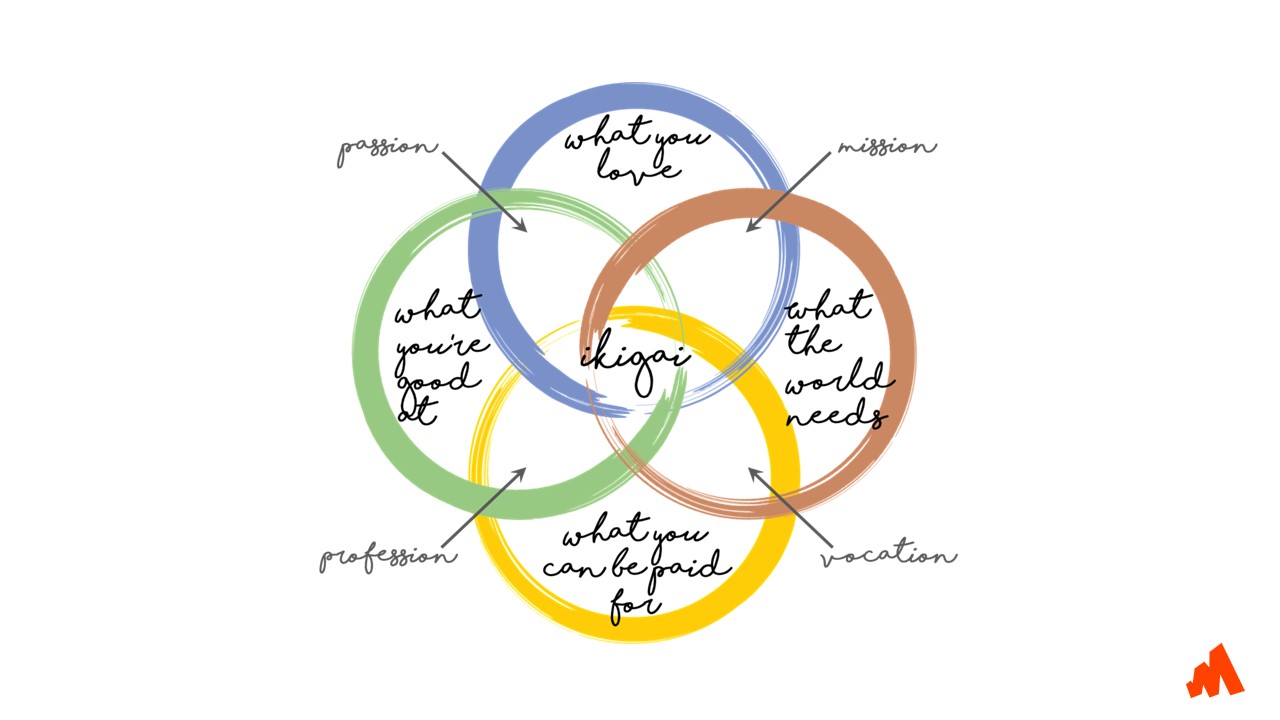
Prioritising self-reflection and expressing gratitude through practices like journaling can nourish our spiritual energy and enable us to forge deeper connections with ourselves. And if you have capacity, seeking to help others can also bring about a deep sense of personal satisfaction!
What is the essence of life? To serve others and do good.
Aristotle
Building energy capacity across the four sources involves balancing energy expenditure with intermittent renewal.
Gradually building our energy capacity in this way and allowing it to become a habit is where the true magic happens. Unlike relying solely on willpower and discipline, which demand significant energy and effort, positive rituals naturally draw us in and require less energy. Which creates a win-win situation.
Great performers, whether they are athletes or fighter pilots, surgeons or Special Forces soldiers, FBI agents or CEOs, all rely on positive rituals to manage their energy and achieve their goals.
Jim Loer and Tony Schwartz
The ultimate objective is to effectively manage our energy from all four sources, allowing us to consistently become who we want to be as much of the time as possible!
Wishing you a great break and a fantastic start to 2026.
Charlie


